Yonsei Kim & Lee Dermatology Doctor's Column
Dermatology Column

When Is a Skin Booster a Better Choice Than Filler?

How water-glow injections (skin boosters) and fillers differ in ingredients and purpose, why results can be slow to appear, and the safety criteria to check.

Published 2026-10-30 Updated 2026-10-30 Reviewed by Taehyung Kim, Medical Director · Dermatology Specialist

A hyaluronic acid-based skin booster works on a different principle from a filler, which builds shape. While a filler creates volume and contour with cross-linked hyaluronic acid, a skin booster adds a small amount of a cross-linked component to low- and high-molecular-weight hyaluronic acid to fill in hydration and refine skin texture.

This column sets out how the two treatments differ in principle, why results can be slow to appear, and the safety criteria to check. Success depends less on the ingredient than on an injection plan tailored to each individual.

01

Do skin boosters differ from fillers right down to the ingredients?

Key point
Fillers use cross-linked hyaluronic acid to build volume and shape, whereas a skin booster combines low- and high-molecular-weight hyaluronic acid with a small amount of a cross-linked component to improve the skin's hydration and texture. Because the purposes differ, the choice should follow the result a person wants.

A filler uses cross-linked hyaluronic acid to create supporting strength, and its purpose is to build shape and volume in areas such as the nose or lips. A skin booster is a blended formula in which 5% cross-linked hyaluronic acid is added to low- and high-molecular-weight hyaluronic acid, and it supports the skin's hydration, firmness and texture.

Rather than ranking the two treatments, it is important to decide the purpose first: building shape and volume, or filling in skin density and refining texture. Setting this criterion in advance makes it much easier to choose the treatment that fits a person's concern during the consultation.

  • Low — molecular-weight hyaluronic acid — its small molecules are absorbed quickly and fill in hydration
  • High — molecular-weight hyaluronic acid — stays in the skin and sustains the improvement in firmness and texture
  • 5% cross — linked hyaluronic acid — adds natural-looking volume together with a soft feel
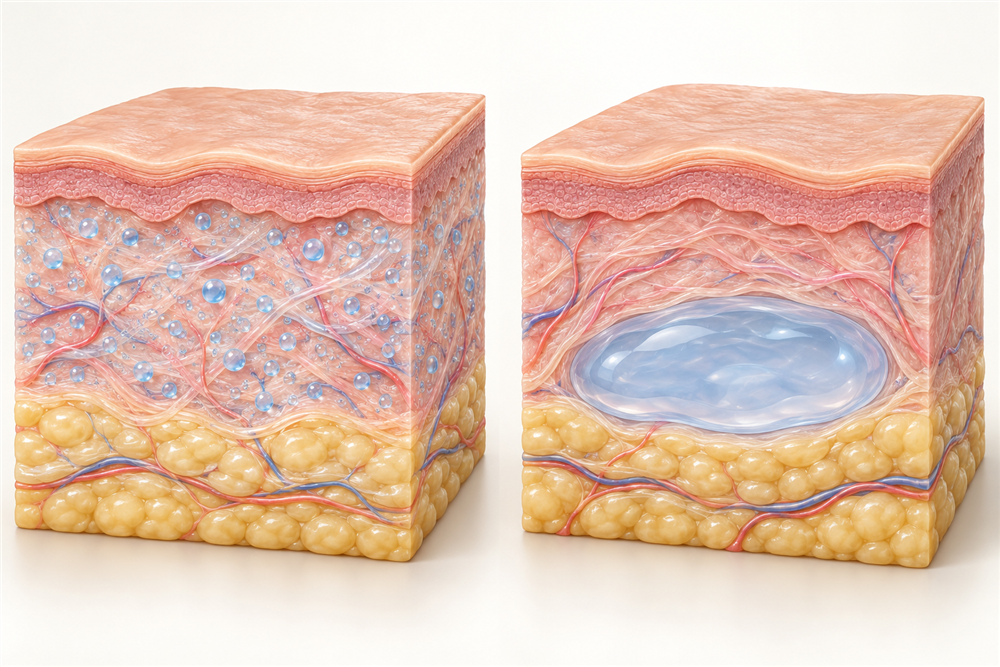
Anatomy illustration related to When Is a Skin Booster a Better Choice Than Filler?
02

In which cases is a skin booster particularly helpful?

Key point
A skin booster is particularly helpful for skin that is dry beneath the surface, feeling tight after cleansing or making makeup lift, for people who find the artificial look of fillers a burden, and for those aged 30 or older in whom nasolabial folds and ageing changes have begun.

When the face easily feels tight after cleansing or makeup keeps lifting, this can be read as a sign that the skin lacks moisture beneath the surface, and a skin booster in which low- and high-molecular-weight hyaluronic acid act together helps to make up for this inner dryness.

A skin booster is also worth considering early when the artificial look typical of fillers feels like a burden, when nasolabial folds have just begun to show faintly, or when a person aged 30 or older notices general ageing changes. The actual effect, however, can vary with the individual's skin condition and the injection plan.

  • Inner dryness after cleansing — skin that feels tight after washing and on which makeup lifts
  • The artificial look typical of fillers — refers to cases where a natural-looking result is wanted
  • Early changes in the nasolabial folds — the stage at which the folds begin to show faintly
  • Ageing changes from age 30 onward — the age range in which signs such as reduced firmness appear
03

What does it mean if there is no effect even 4 weeks after the treatment?

Key point
Time is needed for the skin's hydration and condition to recover and for firmness to return, so some waiting is part of the process. If there is still no change after 4 weeks, however, the first thing to check is whether the injection plan was tailored to the individual.

Firmness returns gradually only after moisture has been replenished within the skin and its condition has recovered, so a certain amount of time is a necessary part of the process. If no change is felt even after 4 weeks, it should be checked again whether the plan took into account the purpose, the area, the skin's thickness and dryness, and its ability to retain moisture.

When volume and lifting are the purpose, about 5 points are chosen and the product is injected in a concentrated way into areas such as deep nasolabial folds or hollowed cheekbones. When the purpose is to improve skin texture or inner dryness, it is spread widely and gently without concentrating on a particular area, and the result depends on the plan and the technique.

Anatomy illustration related to When Is a Skin Booster a Better Choice Than Filler?
04

Is a larger dose always better?

Key point
A larger dose does not always lead to a better result, and spreading a small dose over a wide area is not automatically the sensible approach either. The key is to set the dose according to the area to be improved and the purpose of the treatment.

Someone who wants a subtle glow and hydration and someone who wants to fill the volume of hollowed cheeks need different doses, so injecting a large amount does not make the result better. It is sensible to decide first which area is to be treated and for what purpose, and then adjust the dose.

When a gel form that needs no separate dilution step is used, the likelihood of nodules is on the low side. Even so, this risk can be reduced further only when the product is injected in a way that lets the skin recover by itself, rather than simply being filled in.

Taehyung Kim, Medical Director
Doctor's view

How the doctor decides

Taehyung Kim, Medical Director · Dermatology Specialist

I look at the plan before the ingredient

I check how an ingredient will be placed before I look at which ingredient is used. If volume and lifting are the purpose, I keep the points narrow and inject in a concentrated way into the areas that need it; if the purpose is to improve skin texture and inner dryness, I choose to spread the product widely and gently without focusing on a particular area.

I set the dose according to the purpose

I do not think that injecting more makes the result better. A patient who wants a subtle glow and hydration and a patient who wants to restore lost volume need different doses to begin with, so in consultation I ask 'where, and for what purpose' before I ask 'how much'.

I manage the possibility of nodules through the injection method

Even when a gel form that needs no separate dilution step is used, I judge that the risk of nodules can be reduced only by injecting in a way that lets the skin recover by itself, rather than by simply filling it in. For that reason I check skin thickness and moisture retention together before the treatment, and I try to explain in advance the method that fits the purpose.

Summary

In summary

A skin booster and a filler are not better or worse than each other; they are treatments with different purposes. A filler may suit someone who wants shape and volume, and a skin booster may suit someone who wants better skin texture and hydration. If there is no change even after 4 weeks, the injection plan and the dose should be reviewed. Anyone with inner dryness or early changes in the nasolabial folds would do well to have a medical consultation.

FAQ

Frequently asked questions

QAre water-glow injections and skin boosters the same treatment?
A

Water-glow injection is a general term for hyaluronic acid treatments, and a skin booster that adds a 5% cross-linked component to low- and high-molecular-weight hyaluronic acid is included in it. The ratio of ingredients differs from product to product, so it should be confirmed in consultation.

QWhen does the effect start to be felt?
A

Time is needed for moisture to be replenished within the skin, for its condition to recover and for firmness to return. If there is no change even after 4 weeks, the injection plan should be checked again.

QCan nodules form?
A

When a gel form that needs no separate dilution step is used, the likelihood of nodules is on the low side. However, the risk can be reduced further only when the treatment is carried out in a way that lets the skin recover by itself.

QHow is the dose decided?
A

The dose is decided not by more or less but by the area to be improved and the purpose. When volume and lifting are the purpose, the points are kept narrow; when improving skin texture is the purpose, the product is applied widely.

Taehyung Kim, Medical Director
Medical review
Taehyung Kim, Medical Director · Dermatology Specialist
This content is general medical information and may not apply to every individual. Diagnosis and treatment are decided through a consultation.